
There comes a moment in every well-designed vocational training programme when learning moves beyond theory and becomes transformative. For Wadzanai Mudyanadzo, a 19-year-old from Mutanda Ward 2 in Mutare, Zimbabwe, that moment came when she successfully completed the installation of a 5kW solar system within her own community.
Wadzanai is one of the graduates of Simukai Vocational Hub’s outreach training programme, which brings vocational education directly into underserved communities across Zimbabwe. Her journey reflects the core pillars of the SUSTAIN-IT Project: environmental sustainability, inclusion and digital transformation.
Mutanda Ward 2 is an off-grid community where firewood has traditionally been the primary source of energy. This dependence contributes to deforestation, soil erosion and indoor air pollution, while also placing significant social and economic pressure on households. Women and girls are often responsible for collecting firewood, and prolonged exposure to smoke from wood-burning fires remains a major health concern in many rural communities across Sub-Saharan Africa.
Through Simukai Vocational Hub’s renewable energy training, Wadzanai and her fellow learners gained practical skills in solar installation, electrical systems, system sizing and troubleshooting. Rather than studying environmental challenges in theory, students were encouraged to identify real community needs and develop practical solutions through hands-on learning.
This approach strongly reflects the vision of the SUSTAIN-IT Project, which promotes environmentally focused Technical and Vocational Education and Training (TVET) that equips learners with practical green and digital skills capable of addressing local challenges.
Wadzanai’s story also highlights the importance of inclusion in vocational education. As a young woman from a remote rural community entering the renewable energy sector, she represents a growing movement of women participating in technical and traditionally male-dominated fields.
Importantly, Simukai Vocational Hub’s outreach model reduced barriers to participation by bringing training directly to local communities rather than requiring students to travel to centralised institutions. This community-based approach helps ensure that access to quality vocational training is not determined by geography or economic circumstances.
Today, Wadzanai and her fellow graduates are actively supporting the transition to renewable energy within their community. By promoting the adoption of solar energy systems, they are helping to address energy poverty, reduce reliance on firewood and contribute to environmental sustainability within Mutanda Ward 2.
Each solar installation represents more than access to electricity. It is also a practical example of environmental problem-solving, renewable energy innovation and community development in action.
For the wider SUSTAIN-IT community, Wadzanai’s journey demonstrates the impact that inclusive, environmentally focused and technology-driven vocational education can achieve. When young people are equipped with the right skills, support and opportunities, they become active contributors to sustainable development within their own communities.
The transition from firewood to solar energy in Mutanda Ward 2 is already underway, and young people like Wadzanai are helping to lead that change.
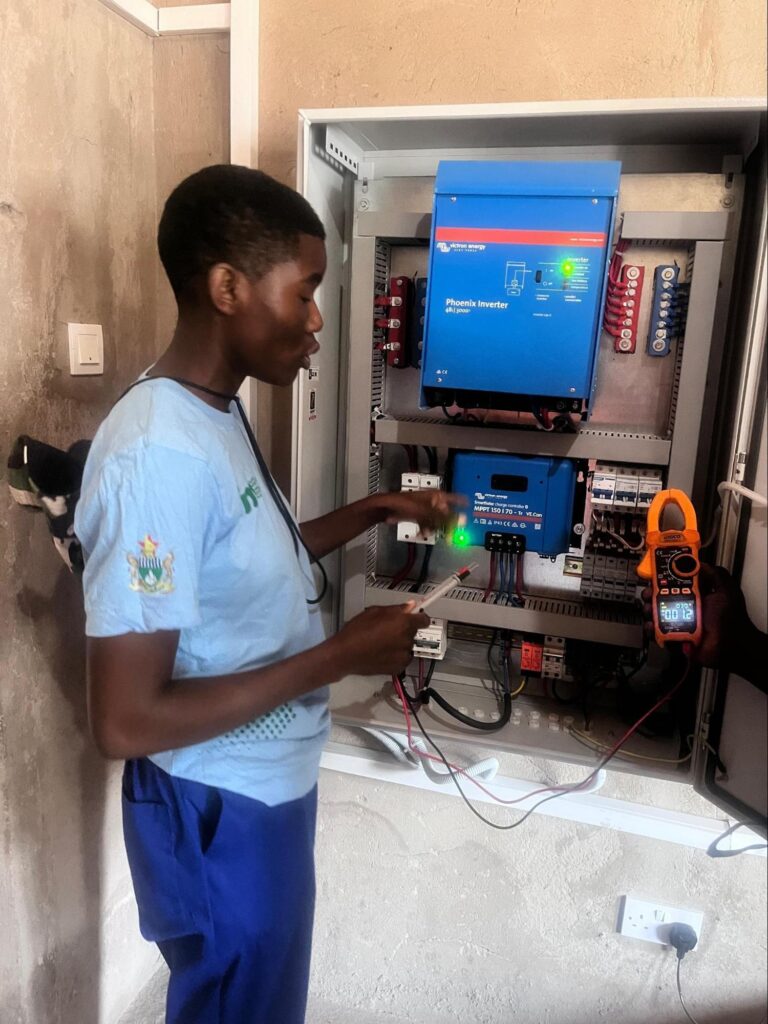
Wadzanai (19) a graduate from Simukai Vocational Skills Training Hub demonstrating how she installed 5kv solar system in Mutare rural